MENOPAUSE IS NOT A PERSONALITY FLAW
Why Midlife Women Are Struggling. and Why It’s Not Their Fault
There comes a moment in every woman’s midlife , sometimes while holding an empty mug and trying to remember why she walked into the kitchen, when she asks herself: “Am I losing my mind?”
At Menopolooza 2025, the sold out gathering we hosted in Victoria, BC with 150 women, we discovered the answer:
No. You are not losing your mind.
You are losing patience for a healthcare system that forgot you existed.
The Biggest Symptom Isn’t a Hot Flash , It’s Confusion
Our data revealed that the most distressing part of perimenopause isn’t the physical symptoms. It’s not knowing what’s happening to you, and finding out that neither does your doctor.
Women wrote things like:
“I clearly don’t know anything. Nobody should feel this uninformed.”
“How do I get my doctor to listen to me?”
“Why are we not teaching this?”
This isn’t about women lacking literacy- this is about a training failure at scale.
Mental health clinicians can access education on anxiety, pregnancy, postpartum, and eating disorders, but in terms of education and research on the mental health impacts of menopause, despite the fact that it affects over a billion women globally, there is a total gap of resources.
There is more clinical guidance on addiction during pregnancy than on the decade long neuroendocrine transition that half the population will navigate.
This gap has consequences.
Perimenopause Looks a Lot Like “Mental Illness” , But Isn’t
Using Grounded Theory, we synthesized themes across hundreds of notes, drawings, and lived experience reflections. One core finding emerged:
Perimenopause feels like the collapse of self-efficacy.
Women described:
“full mind–body exhaustion”
“brain fog”
“instant inability to cope with stressors”
“lack of motivation to self advocate”
“feeling flat, dead, or unlike myself”
“perimenopausal rage”
“loss of libido and emotional warmth”
If men experienced these symptoms en masse, there would already be a national task force and a line of over the counter hormone gummies at Costco…
Instead, women get told to “slow down,” “relax,” or “be patient.”
We would love to.
But the system is keeping us too busy navigating a medical scavenger hunt for answers.
The Great Menopause Diagnostic Ping-Pong
Our participants described symptoms across nearly every system:
itchy ears
vertigo
migraines
frozen shoulder
hair loss
weight changes
anxiety spikes
joint pain
digestive chaos
insomnia
relationship strain
Here’s the kicker: women often got bounced from provider to provider because no one could explain how all of these could be linked.That’s because traditional training doesn’t connect menopause with multi-system symptoms, even though our lived data clearly shows an integrative pattern.
Despite all this, women continue:
working full-time
caregiving for aging parents
supporting adult kids
keeping households running
navigating grief and divorce
managing workplaces
googling “am I dying or is this perimenopause” at 2:13 AM
We call this resilience.
But let’s be honest, this is public service.
If society understood how much women are doing while under-slept, under-estrogened, and under-informed, we’d either:
award medals, or finally fund menopause care. Both would be appropriate.
What Actually Helps (Clue: It’s Not Telling Women to Meditate More)
Women told us what genuinely moved the needle:
validation (“you’re not crazy”)
friends and peer support
strength training and movement
pelvic floor physiotherapy
nutrition that fuels the brain and body
clinicians who actually listen
realistic strategies
symptom tracking
time in nature
Healing wasn’t about “fixing” women. It was about witnessing them. It was about clinicians saying: “This is real, and I believe you.”
Validation turned out to be treatment.
The Problem Isn’t Our Bodies , It’s the System
Page after page of Menopolooza data revealed the same themes:
Institutional neglect
Menopause literacy is not standard in medicine, counselling, recovery programs, or nursing.
Healthcare gate-keeping
Women are denied iron infusions until they are barely functioning, and many cannot access hormone literate providers at all.
Mental health blind spots
Midlife is a high risk period for suicide, relapse, anxiety, and depressive symptoms , yet recovery models rarely name this.
Women doing unpaid diagnostic labour
We are crowd-sourcing symptom management in Facebook groups because the system offers no roadmap.
This is not a women’s issue, this is a public health issue, and it requires systemic change, not more self-help articles.
Imagine If We Actually Taught This Stuff?
Here is what women demanded , and what our data confirms the system needs:
Menopause literacy integrated into every medical and mental health curriculum
No-referral access to hormone literate clinicians
Multidisciplinary menopause clinics
Complex Care Codes for perimenopause and menopause treatment in primary care
Public health campaigns normalizing midlife transitions
Recovery programs that account for hormonal shifts
Research that includes women over 45 (radical!)
Early menopause education so the next generation isn’t blindsided
If we did this, women wouldn’t just cope better , they would thrive.
And society would benefit from the full power of middle aged women instead of losing them to burnout, confusion, and untreated symptoms.
The Future Is Women Gathering in Rooms and Refusing Silence
Menopolooza proved something revolutionary:
Connection heals what the system can’t.
Women spoke, cried, laughed, raged, drew maps, corrected misinformation, and built a model of care that should have existed decades ago. They generated the educational blueprint that institutions have failed to provide.They stopped whispering. They started leading. And they reminded us that menopause isn’t an ending. It’s a rite of passage , one that deserves dignity, humour, evidence based care, and a healthcare system that finally shows up.
5 Things Every Mental Health Professional Must Know About Menopause
1. Perimenopause can mimic psychiatric symptoms.
Fatigue, brain fog, irritability, anxiety, and motivation loss are endocrine driven, not character flaws.
2. Midlife is a predictable relapse risk window.
Hormonal shifts + caregiving load + identity upheaval = heightened vulnerability.
3. Women are not being dramatic , they are being dismissed.
Validation alone improves outcomes.
4. “Weird” symptoms are real.
Itchy ears, frozen shoulder, histamine flares, migraines, GI changes , all appear in our qualitative data.
5. Lack of clinician training is the barrier , not lack of patient effort.
Women are not noncompliant.
They are navigating unprepared providers.
Bryn Meadows, MA, MPCC, is a clinical counsellor, researcher, and founder of Menopolooza, a women’s midlife and menopause movement reshaping how clinicians and communities understand hormonal transitions. Her work combines grounded theory research, mental health expertise, and a fierce commitment to making menopause a public health priority rather than a private struggle. She lives in Victoria, BC, where she hosts conferences, facilitates healing spaces, and continues her mission to ensure no woman navigates midlife confused, dismissed, or alone.
Who's Afraid of Vagina Woolf?

A Serious Look at UTIs, Vaginal Estrogen, and Why We're Failing Postmenopausal Women
In our cultural discomfort with all things postmenopausal, women are suffering silently while UTIs spiral into delirium, chronic pain, and unnecessary institutionalization. The silence is dangerous. And the solution? Surprisingly simple:
Let’s talk about vaginas.
Did you know that many- again- MANY women in midlife are being misdiagnosed with dementia when they actually have a UTI?
Not a mild one. A full-blown, body-altering, brain-fogging, confusion-causing urinary tract infection.
And here’s the kicker: they don’t even know they have it—because no one’s talking about their vagina.
Not their doctors. Not their friends. Not even the women themselves.
Why? Because we’ve all been trained to treat the post-menopausal vagina like a shameful
ghost town.
Unmentionable. Unseen. Unworthy of care.
There’s stigma.
There’s misogyny.
There’s so much silence.
And that silence? It’s making women sick, scared, and misdiagnosed.
Starting off, here are some of the symptoms/ implications of untreated UTIs in Postmenopausal Women:
1. Recurrent UTIs Become the New (Unwanted) Norm
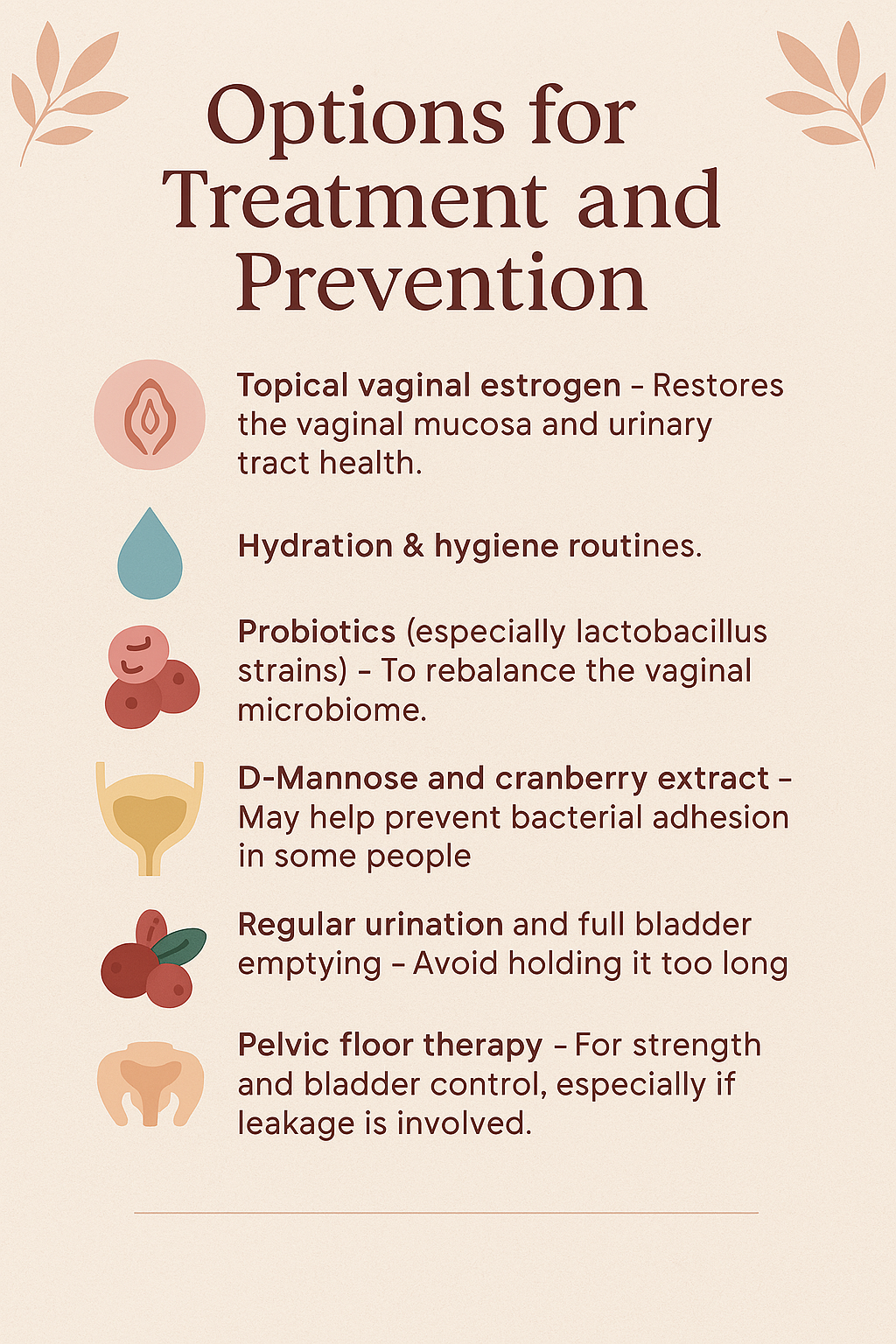
Estrogen levels drop after menopause, which leads to thinning of the vaginal and urinary tract lining, a shift in pH, and less protective flora (RIP, friendly lactobacilli). This all makes it easier for bacteria to invade—and if one infection isn’t cleared properly, it often invites *more*.
2.Increased Risk of Kidney Infections (Pyelonephritis)
A lower UTI (bladder infection) left untreated can migrate up the urinary tract to the kidneys. Kidney infections can be severe, painful, and may require hospitalization—especially in older women whose immune response may already be compromised.
3.Delirium and Confusion
This is a big one: in older adults, especially those 65+, untreated UTIs can cause **sudden- onset confusion, agitation, and even delirium**—often mistaken for dementia or stroke. It’s called "delirium due to UTI" and can be *scary* if you don’t know what you’re looking at.
4.Chronic Bladder Inflammation
Repeated infections can lead to interstitial cystitis or chronic bladder irritation, causing long-term pelvic pain and urinary urgency—even between infections.
5.Urinary Incontinence or Worsening Symptoms
Untreated infections can contribute to (or worsen) stress or urge incontinence, increasing the sense of loss of control and affecting confidence, intimacy, and quality of life.
6.Sepsis
Rare but very serious: if a UTI becomes systemic and bacteria enter the bloodstream, it can result in uro-sepsis, a life-threatening condition—especially dangerous in older or immunocompromised people.
7. Sexual Health Impacts
Painful urination, irritation, and inflammation affect intimacy, and untreated infections can deepen the cycle of avoidance and distress around sex and pelvic touch.
8. Emotional and Mental Health Strain
Chronic or untreated UTIs contribute to frustration, embarrassment, isolation, and anxiety. The unpredictability of symptoms can make outings, work, or intimacy feel risky or exhausting.
SO OUT OF ALL THE THINGS- CAN WE FIRST SKIP BACK TO NUMBER 3…………..
WHHHAAAAATTTTTT THE FFFFFFFF.
Let’s begin with the basics: Urinary tract infections (UTIs) are not just pesky little bathroom inconveniences. For postmenopausal women, they can be the stuff of literal nightmares—causing everything from searing pain to confusion that mimics dementia. DEMENTIA!!
And yet, somehow, our medical response to this very preventable condition often swings between “Here, have some more antibiotics” and “Let’s never speak of your vagina again.”
Welcome to the weird world of postmenopausal health, where we treat symptoms like they're embarrassing secrets and ignore prevention like it’s an uninvited guest at the wellness table.
Let’s continue:
The Delirium is Real (and Often Misdiagnosed)
Let’s talk about delirium—sudden confusion, disorientation, or agitation that can look like the onset of dementia or a really bad mushroom trip. UTIs are a leading reversible cause of delirium in older adults, especially women (Inouye et al., 2014). The kicker? Delirium caused by a UTI can be *the only symptom*. No burning. No urgency. Just grandma suddenly accusing the dog of espionage.
A 2023 systematic review confirmed the strong link between UTIs and acute delirium in older women (Gharbi et al., 2023). But in clinical settings, these episodes are too often misattributed to dementia—setting women up for a long, unnecessary journey into specialist referrals, memory clinics, and a general gaslighting of their embodied reality.
Why Are We Reacting Instead of Preventing?
Because apparently, prevention is still controversial when it comes to the postmenopausal vagina. Despite vaginal estrogen therapy being clinically proven to reduce recurrent UTIs by up to 75%** (Perrotta et al., 2008; Raz & Stamm, 1993), it remains wildly under-prescribed. In Canada, tens of thousands of women over 40 are prescribed antibiotics for UTIs every year (Nicolle, 2009; Rowe & Juthani-Mehta, 2013). Meanwhile, vaginal estrogen—a low-cost, low- dose, low-risk intervention—is sidelined, dismissed, or never even mentioned. One BC study showed UTI-related antibiotic prescriptions dropped 73% when better stewardship and prevention measures were introduced (Sears et al., 2023). Prevention works. We're just not doing it.
But What About the Side Effects?
Antibiotics are not benign. Overuse contributes to antimicrobial resistance, gut dysbiosis, yeast infections, and drug interactions that can be particularly dangerous for older women (Public Health Ontario, 2020). Fluoroquinolone's, once the go-to UTI treatment, have been linked to tendon rupture and nervous system damage—so why are they still prescribed when topical estrogen could reduce the need in the first place?
Is it Shame? Or Just Bad Policy?
Let’s not tiptoe around it: we do not like talking about postmenopausal vaginas. There’s a cultural discomfort here that translates directly into clinical neglect.
Vaginal dryness? Too awkward.
Incontinence? “Just part of aging.”
Recurrent infections? “Here’s another prescription.”
There is a long-standing history of medical misogyny—the belief that women’s complaints are exaggerated, emotional, or irrelevant. When combined with ageism and sexual shame, you get a toxic cocktail where women suffer in silence while their providers remain untrained, uninterested, or unwilling to prescribe effective, evidence-based treatments. And the irony? The one thing we *should* be talking about—the vagina—is the one thing no one wants to name. It’s not Voldemort, people. It’s just estrogen.
The Wolf at the Door
If we continue to ignore the connection between untreated UTIs, delirium, and the gross underutilization of preventive care like vaginal estrogen, we’re inviting bigger health crises: unnecessary hospitalizations, institutionalizations, and a steady march of women misdiagnosed with dementia when all they needed was a vag cream.
Who's afraid of Vagina Woolf? Apparently, all of us. And it's time to get over it.